You can probably easily pick out the salmon just by looking for that peachy-pink color as you walk through the seafood section in your local supermarket.
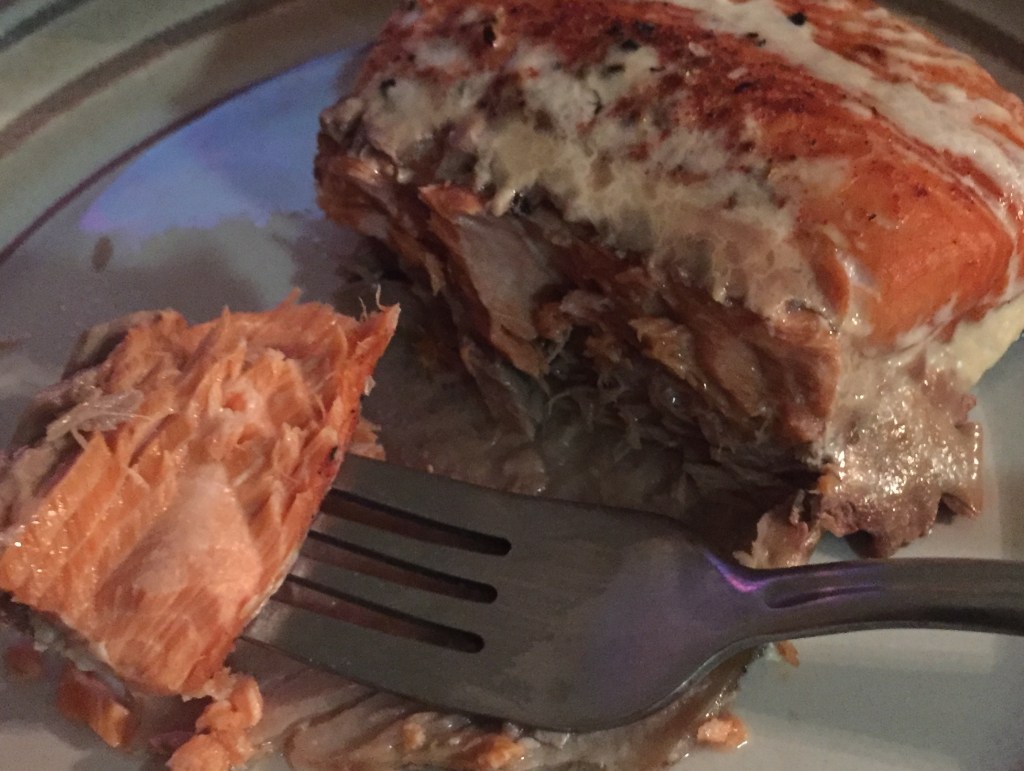
You can probably easily pick out the salmon just by looking for that peachy-pink color as you walk through the seafood section in your local supermarket.
Photo Credit: Alexandra Pounds
Salmon gets its trademark color from a chemical called “astaxanthin” in its feed, regardless of whether it’s wild or farm-raised. Astaxanthin is a type of “carotenoid”, which are antioxidant pigments naturally found in a variety of foods. For example, carotenoids are what give carrots and papayas their orange color.
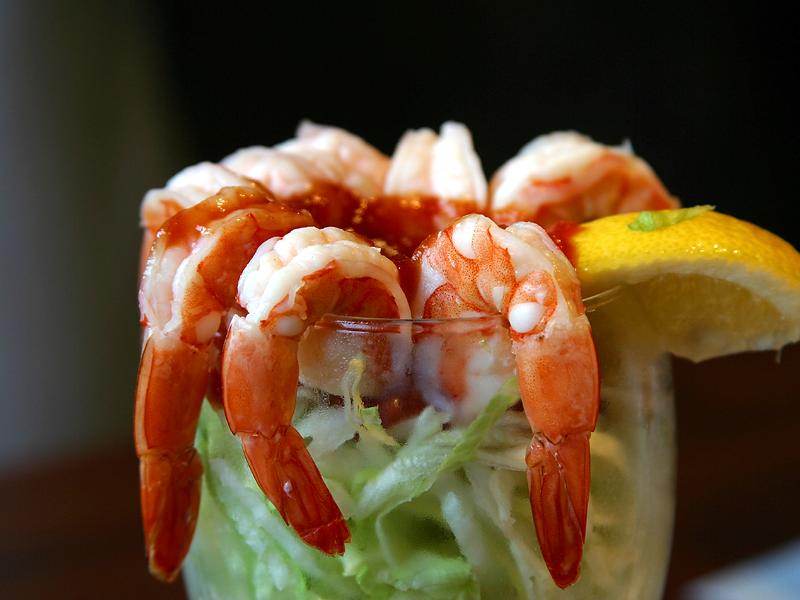
Wild salmon generally eat smaller fishes, shrimps, and krill. Shrimp and krill contain astaxanthin and other carotenoids (1). Astaxanthin is what gives farmed salmon it’s trademark color. The more shrimp and krill the salmon eats, the darker its flesh will be because astaxanthin accumulates in its body.
Photo Credit: https://en.wikipedia.org/wiki/Cocktail_sauce
Because farmed salmon don’t have access to shrimp and krill, farmers must add astaxanthin to pellets. Typically, farmers add astaxanthin that has been produced by yeast and algae (2). Certain sensationalized public media sources criticize farmed salmon for using “artificial food dye” to color the salmon flesh. While the European Commission classifies this ingredient as a “food dye” (3), astaxanthin also plays an important role as an antioxidant, keeping the fish healthy (4).
Consumers are willing to pay more for darker salmon because they associate the darker color with higher quality (1, 5). There’s some truth to this: astaxanthin has health benefits for humans as well as salmon (6).
But astaxanthin isn’t the only nutritious component to salmon. Salmon – farmed or wild – is the best source of omega-3 fatty acids, and provides a wide variety of micronutrients contributing to a healthy diet. So regardless of how strong the color is, rest assured that you’re still going to get a highly nutritious meal!
- Anderson, S. Salmon Color and the Consumer. Microbehavior and Macroresults: Proceedings of the Tenth Biennial Conference of the International Institute of Fisheries Economics and Trade, July 10-14, 2000, Corvallis, Oregon, USA. Compiled by Richard S. Johnston and Ann L. Shriver. International Institute of Fisheries Economics and Trade (IIFET), Corvallis, 2001. Available at: https://ir.library.oregonstate.edu/concern/conference_proceedings_or_journals/9s1616848
- Ambati RR, Moi PS, Ravi S, Aswathanarayana RG (2014) Axtaxanthin: Sources, Extraction, Stability, Biological Activities and Its Commercial Applications – A Review. Marine Drugs, 12(1), pp 128-152. Available at: https://www.ncbi.nlm.nih.gov/pmc/articles/PMC3917265/
- European Commission Regulation (EC) No 1288 (2014). Available at: https://eur-lex.europa.eu/legal-content/EN/TXT/HTML/?uri=CELEX:32004R1288&from=EN
- Lim KC, Yusoff FM, Shariff M, Kamarudin MS (2017) Astaxanthin as feed supplement in aquatic animals. Reviews in Aquaculture, 10(3), pp. 738-773. Available at: https://onlinelibrary.wiley.com/doi/full/10.1111/raq.12200
- Alfnes F, Guttormsen AG, Steine G, Kolstad K (2006) Consumers’ Willingness to Pay for the Color of Salmon: A Choice Experiment with Real Economic Incentives. American Journal of Agricultural Economics, 88(4), pp 1050-1061. Available at: https://academic.oup.com/ajae/article/88/4/1050/77843
- Capelli B, Talbott S, Ding L (2019) Astaxanthin sources: suitability for human health and nutrition. Functional Foods in Health and Disease, 9(6). Available at: https://ffhdj.com/index.php/ffhd/article/view/584
 Fish By The Pounds